
Your needs, this model
Does it fit your priorities?
What does the US page establish about the shell construction and fabric?
It identifies a seam-sealed FUTURELIGHT 3L shell with 7D x 15D, 79 g/m² fabric made from 100% recycled nylon. The page does not call the fabric ripstop, and its grams-per-square-metre figure is fabric mass rather than a whole-jacket weight or a waterproofness score.
Explore this need in the finder →Can this jacket be packed into one of its own pockets?
Yes. The checked US product page identifies a secure-zip pocket on the right hip as the stow pocket. It does not give packed dimensions or say that the pocket includes a loop for clipping the packed jacket to a pack.
Explore this need in the finder →Does the model meet a requirement for underarm pit zips?
The reviewed US feature list does not name underarm pit zips. It does describe the two-way center-front zipper as useful for ventilation and pack access, but that is not an underarm opening and does not satisfy the pit-zip filter. The pit-zip field remains unconfirmed rather than being inferred absent.
Explore this need in the finder →Does the fluorine-free DWR description prove the jacket is made without intentionally added PFAS?
No. The exact page calls the DWR finish fluorine-free, but it does not provide the questionnaire's more specific statement about components made without intentionally added PFAS. That field is therefore left unknown; the wording is not converted into a broader PFAS-free claim.
Explore this need in the finder →This is a source-based assessment of the men's Summit Superior FUTURELIGHT jacket, style NF0A86WG. The North Face frames it for trail running and describes a seam-sealed, waterproof-breathable three-layer shell. The strongest documented reasons to consider it are its shell-only setup, a self-stowing hip pocket and a very light published fabric specification. The important cautions are equally concrete: the US page does not give the complete jacket's weight, a measured rain or breathability result, or confirmed underarm pit zips. No hands-on use or independent testing is represented here.
A shell aimed at moving fast
The product page calls this a shell layer and identifies the garment as a seam-sealed FUTURELIGHT 3L jacket designed around trail-running needs. That is a clearer use case than a general-purpose insulated coat: the wearer supplies warmth separately and can adjust clothing beneath the shell for conditions. The record does not provide a temperature rating, so a three-layer label should not be mistaken for insulation or a promise of comfort at a particular temperature.
The three-layer construction is an explicit maker specification, not an outcome measurement. The North Face calls the fabric waterproof and breathable, but the checked US page supplies no numeric hydrostatic-head or breathability result. This review therefore treats those as manufacturer claims. If a buying decision depends on a minimum tested rating, the current source does not establish that requirement.
What the fabric number does—and does not—say
The US material line identifies 7D x 15D FUTURELIGHT 3L fabric at 79 g/m², made from 100% recycled nylon bonded fabric. This makes the exact jacket relevant to someone prioritizing a documented recycled-nylon three-layer shell. But the page does not call the face ripstop or name its weave. A recycled-nylon-ripstop filter is narrower than recycled nylon alone, so this model should not be represented as meeting that requirement on the available source.
Likewise, 79 g/m² measures fabric mass per unit area; it is not the weight of a finished jacket. The product page shows a qualitative weight scale but gives no whole-garment figure. That leaves a real packing trade-off unresolved: the brand presents the style as ultra-lightweight, yet there is no sourced jacket mass here to compare with a competing shell's listed weight. Treat the maker description as positioning, not an independent scale reading.
Pocket stow is the practical highlight
The page explicitly says the jacket stows in its own pocket and identifies a secure-zip pocket on the right hip. This is useful for a runner who wants a documented way to reduce loose-shell bulk between wet sections. It does not tell us the packed dimensions, how readily the jacket fits into the pocket for every size, or whether there is a loop for clipping the bundle to a pack. If pack volume or attachment is the deciding constraint, ask for those exact details rather than extrapolating them from the self-stow feature.
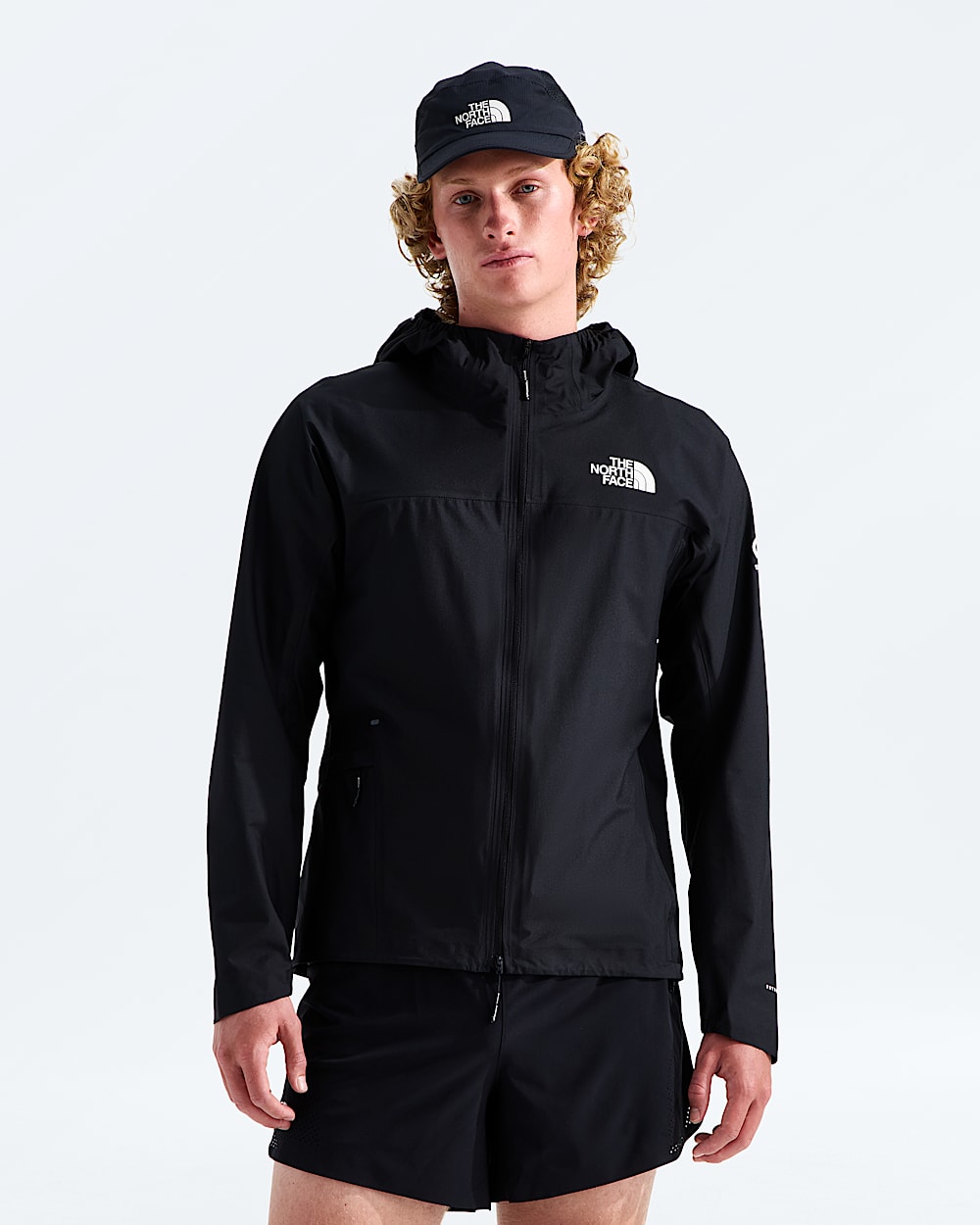
The image used here is the official US TNF Black (JK3) hero asset, whose path carries the NF0A86WG style code. It visually identifies that pictured color and model family; it cannot verify the inner construction, selected size, package or availability. Confirm the base style number on the exact offer. A separately named graphic version is not silently folded into this review.
Ventilation, fit and fit-for-purpose limits
The manufacturer lists a two-way, reverse-coil, water-resistant center-front zipper and says it can help with ventilation and pack access. It does not list an underarm opening or pit zip on the reviewed page. That distinction matters for a runner who vents by opening the jacket while moving versus someone who requires zipped underarm vents. The front closure is a useful documented feature, but it does not satisfy the pit-zip condition and no airflow measurement is offered.
The US product page labels the cut Regular and lists sizes XS through XXL; it also gives a 27.75-inch center-back length. These are product specifications, not a guarantee about body fit or room over a chosen midlayer. Check the current size chart and try to account for the layers and stride of the activity, especially if you expect to wear more than a light base underneath.
For contrast, the separately assessed Men's Summit FUTURELIGHT Torre Egger NF0A8C9A is another three-layer North Face shell, but its US record specifies a recycled-nylon-ripstop main face and underarm zip vents. The Summit Superior instead has the documented hip stow pocket and a 7D x 15D recycled-nylon material line that does not specify ripstop. Neither feature set proves measured superiority; the difference is which exact details the manufacturer publishes. Compare the Torre Egger assessment if pit zips or an explicit ripstop face are central to the decision.
Qualified chemical wording and final checks
The US page calls the DWR finish fluorine-free. That wording is preserved, but it is not expanded into the questionnaire's specific claim about components made without intentionally added PFAS. The page does not establish that narrower statement, so someone requiring it should keep looking for an exact, qualified maker declaration. Unknown does not mean the jacket contains PFAS, and it does not mean the garment is PFAS-free.
The clearest case for NF0A86WG is a men's shell-only trail-running shortlist that values a maker-documented three-layer construction and own-pocket stow. The case weakens if a known garment weight, numeric membrane result, pit zips, ripstop face or specific PFAS statement is essential. Before ordering, verify NF0A86WG rather than the similar graphic-named model, the selected color and size, what is actually included, the seller and return terms. Category presence and a current product page do not guarantee stock or a particular offer.
Key specifications
Key details at a glance
| Shell construction | 3-layer shell |
|---|---|
| Manufacturer fit label | Regular fit |
| Face fabric | 100% recycled nylon bonded fabric |
| Underarm venting | |
| Stows in its own pocket | Yes |
Use the exact model’s instructions for operating limits, supplied equipment and version differences.
Sources for this review
Sources for this assessment

Build a shortlist from documented features
The finder compares explicit product facts, not a rain test, fit guarantee or promise of comfort.