
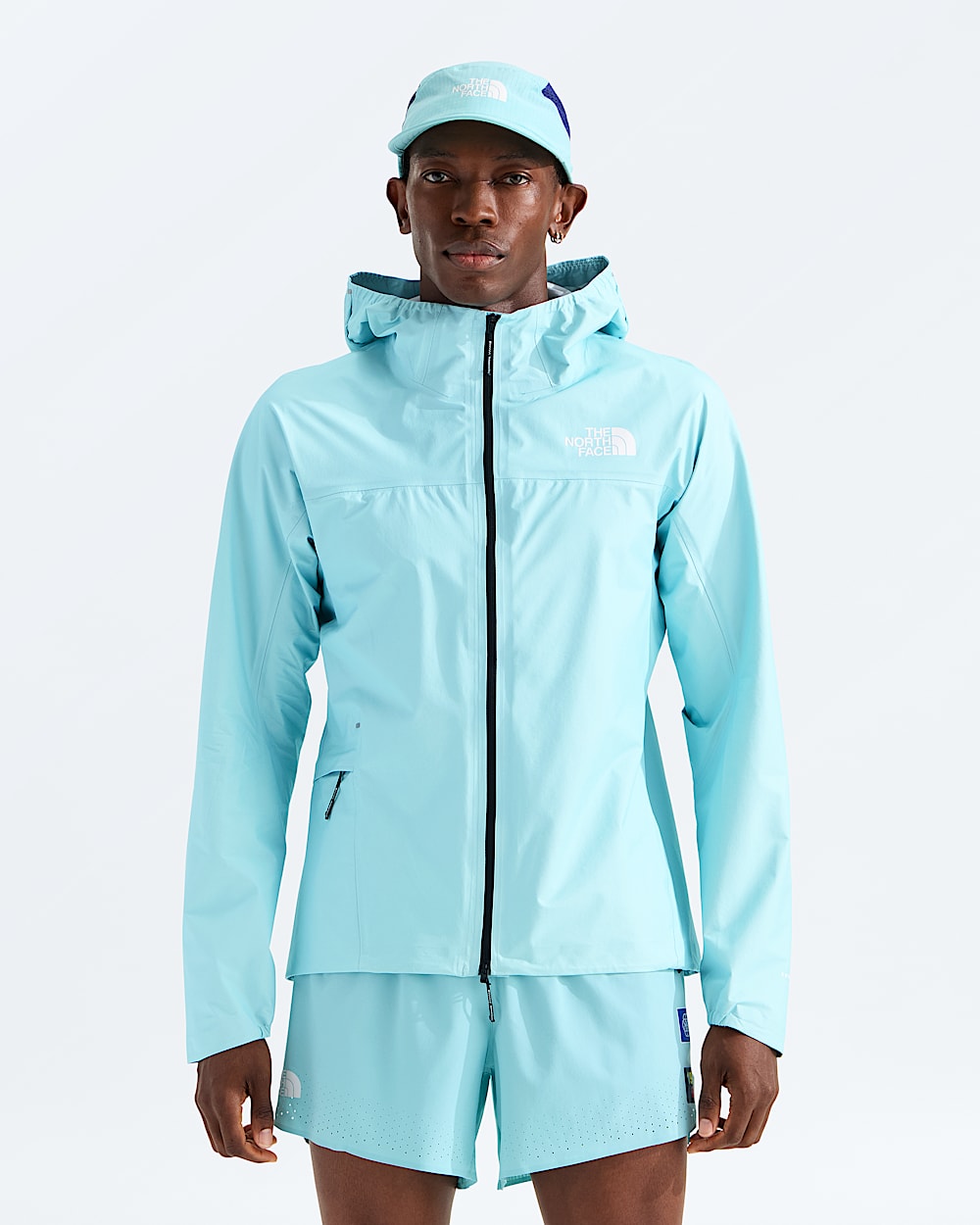
Your needs, this model
Does it fit your priorities?
What is the difference between the listed fabric weight and the jacket's average weight?
The exact NF0A8HW1 US page lists 71 g/m² for its 7D x 15D body fabric and separately lists a 7 oz (202 g) average finished-jacket weight. The first is fabric mass per unit area; the second is the maker's garment-weight specification. Neither is an independent measurement or a rain-performance result.
Explore this need in the finder →Can this shell be packed into one of its own pockets?
Yes. The official US page says it stows in its own pocket and names a secure-zip pocket on the right side. It does not state the packed dimensions or list a loop for clipping the folded jacket to another item.
Explore this need in the finder →Does the reviewed feature list confirm underarm pit zips?
No underarm pit zip is named in the checked US feature list, so the pit-zip selector remains unconfirmed rather than qualifying the jacket. The page calls the two-way center-front zipper useful for ventilation and pack access; that separate closure is not an underarm vent.
Explore this need in the finder →Does non-PFC DWR meet the specific no-intentionally-added-PFAS choice?
The page's non-PFC wording refers to the DWR finish. It does not state that the specified shell materials, membrane and finish are made without intentionally added PFAS, so the narrower questionnaire field remains unknown rather than being marked as a match.
Explore this need in the finder →This is a source-based assessment of The North Face Men's Summit Series FUTURELIGHT Superior Jacket—Graphic, US style NF0A8HW1, in Canal Blue (8EB). The exact US page presents it as a lightweight trail-running shell and specifies a seam-sealed FUTURELIGHT 3L construction, 7D x 15D recycled-nylon body fabric, an average garment weight of 7 oz (202 g), and a pocket-stow route. Those details make it a focused candidate for a runner who wants a documented shell rather than included insulation. They do not amount to a field test, and the page leaves several common requirements unconfirmed: pit zips, ripstop weave, packed dimensions, measured membrane performance and the specific PFAS wording used by our filter.
A running shell, not an insulated system
The North Face describes the jacket around trail-running needs, and its product features identify a seam-sealed, breathable-waterproof FUTURELIGHT 3L shell. The page labels this style a shell layer and does not list an insulating garment or a joined warm layer. That supports a shell-only plan: the wearer chooses the base and midlayers separately. It does not establish warmth at a particular temperature, so the three-layer label should be read as a construction description rather than an insulation rating.
The waterproof and breathable terms are manufacturer claims. The checked US listing does not provide a hydrostatic-head figure, a breathability number or an independent test protocol. The jacket may be considered when the published construction suits a shopper's task, but the source cannot satisfy a strict minimum performance threshold that requires measured results. No rain, ventilation or durability testing is represented here.
Keep fabric mass separate from finished-jacket weight
NF0A8HW1's body-fabric line is 7D x 15D and 71 g/m², made from 100% recycled nylon with a non-PFC durable water-repellent finish. The same page separately lists average jacket weight as 7 oz (202 g). These numbers describe different things: grams per square metre is the mass of fabric over an area, while 202 g is the maker's stated average for the finished jacket. The latter is not a scale measurement made for this assessment, and neither number is a waterproofness or durability result.
The title's “Graphic” label and style code also matter when comparing the product with the separately assessed Men's Summit Superior FUTURELIGHT Jacket NF0A86WG. That non-Graphic style has its own US page and a 79 g/m² fabric figure; NF0A8HW1's page says 71 g/m². The exact pages should not be collapsed into one product record, and the different fabric masses do not by themselves prove that either style is more protective, tougher or more breathable. Review the NF0A86WG assessment if that is the version being considered; its specifications are not transferred here.
Pocket stow is clear; ventilation is not
The exact page says the Graphic jacket stows in its own pocket and names a secure-zip pocket on the right side as the stow destination. That is more specific than a broad “packable” label and makes the feature relevant to a runner carrying a shell between exposed sections. The product page gives no packed dimensions or compressed volume, however, so the stow claim does not tell you how much space it occupies in a vest or how readily the pocket handles every size.
The listed two-way reverse-coil center-front zipper is water resistant and the manufacturer describes it as useful for ventilation and pack access. Underarm pit zips are not named on the reviewed feature list. Because the center closure and an underarm opening are different features, this review leaves pit-zip status unconfirmed instead of counting the front zipper as a match. A shopper who requires pit zips should not rely on the page's general zipper-ventilation wording.
Fit notes and visibility details
The North Face labels the cut Regular, lists sizes XS through XXL and gives a 27.75-inch center-back length. These are useful starting points for comparing a size chart with body measurements, but they cannot predict how the jacket will fit one person or how much room it leaves for chosen layers. The page describes an adjustable hood with a cinch cord and bonded cuffs with partial, pre-tensioned encased elastic. Reflective logos and a lower-back reflective bar are listed as details; they should not be treated as a safety certification or a guarantee of visibility in every setting.
Do not broaden the finish claim
The US material line calls the DWR finish “non-PFC.” That is retained as a finish-specific manufacturer statement. It is not the same evidence as the questionnaire's more specific claim that named components are made without intentionally added PFAS, so the model does not pass that selector. This is not a conclusion that the jacket contains PFAS or is wholly PFAS-free; the exact page simply does not supply that scoped statement.
Who might shortlist it—and what to verify
NF0A8HW1 is a reasonable research candidate when the priority is a men's-block, shell-only trail-running jacket with a stated three-layer build, a published 202 g average weight and an own-pocket stow route. Its documented case weakens if underarm pit zips, explicit recycled-nylon ripstop, numeric weather-performance results, packed volume or the precise PFAS statement are essential. Before choosing an offer, verify the exact Graphic style NF0A8HW1, Canal Blue code 8EB, selected size, the seller's return terms and the package details. The official product record identifies a model and specifications; it does not promise that a particular size or offer is available.
Key specifications
Key details at a glance
| Shell construction | 3-layer shell |
|---|---|
| Manufacturer-listed weight | 202 g |
| Manufacturer fit label | Regular fit |
| Face fabric | 100% recycled nylon |
| Underarm venting | |
| Stows in its own pocket | Yes |
Use the exact model’s instructions for operating limits, supplied equipment and version differences.
Sources for this review
Sources for this assessment
- Men's Waterproof Rainwear, Size M filtered indexed result — The North Face US
- Men's Summit Series FUTURELIGHT Superior Jacket—Graphic, style NF0A8HW1 — The North Face US
- Men's Summit Superior FUTURELIGHT Jacket, style NF0A86WG — The North Face US
- Men's Summit Series FUTURELIGHT Superior Jacket—Graphic NF0A8HW1, Canal Blue (8EB), official US hero image

Build a shortlist from documented features
The finder compares explicit product facts, not a rain test, fit guarantee or promise of comfort.