
Your needs, this model
Does it fit your priorities?
Can the Storm Racer stow in its own pocket?
Yes. Patagonia identifies an integrated stuffsack and says the chest pocket stows the jacket. The page gives no compressed-volume measurement.
Explore this need in the finder →Does style 24112 document a recycled-nylon-ripstop face and three-layer shell?
Yes. Patagonia specifies a three-layer H2No shell with a 2.2-ounce, 20-denier face made from 100% recycled nylon ripstop and a tricot backer. This identifies construction, not comparative abrasion or rain performance.
Explore this need in the finder →Does the manufacturer confirm underarm pit zips?
The checked product page describes a one-pull hood, chest pocket, half-elastic cuffs and drawcord hem, but does not list underarm pit zips. Hood adjustment and a waterproof/breathable claim are not substitutes for documented underarm vents.
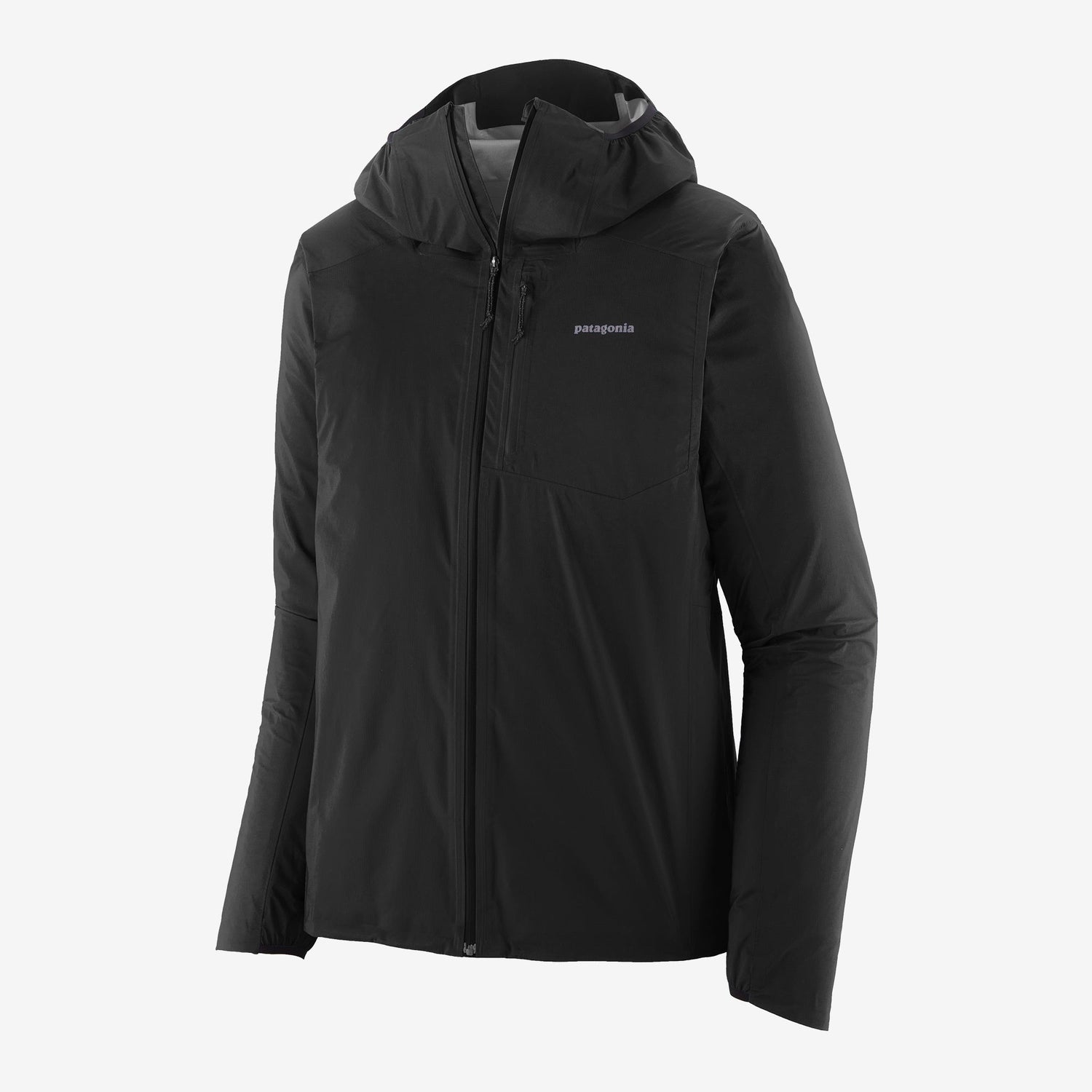
Explore this need in the finder →Patagonia Men's Storm Racer Jacket, U.S. style 24112, is a slim-cut, three-layer rain shell shaped around trail running and compact carry. The manufacturer lists it at 204 g and describes a chest pocket that becomes the jacket's stuffsack. This is an assessment of the published specification, not a wear, fit or rain test; the listed weight and features are not independent measurements of performance.
A construction brief aimed at moving quickly
The 24112 page identifies a featherweight H2No Performance Standard shell with a 2.2-ounce, 20-denier face made from 100% recycled nylon ripstop. A 7-denier tricot backer is listed behind the face, along with a waterproof/breathable barrier and a durable water repellent finish. Patagonia's materials text says that finish is made without intentionally added PFAS. That wording belongs to the stated finish; it should not be upgraded into a blanket claim that every component is PFAS-free.
Patagonia lists 204 g (7.2 oz). The low figure is useful for identifying the design's emphasis, but it is not a promise that the jacket will feel a certain way over your kit, and no size basis is stated alongside the weight. The source supplies no numerical hydrostatic-head or breathability result, no independent test, and no packed-volume measurement. H2No is the manufacturer's named shell standard; it is not a number that can be placed directly beside a rival's lab data here.
The slim running cut is a real tradeoff
The product page calls the fit slim and explains that its close-to-body cut is intended to avoid spare fabric impeding a stride. That purpose makes sense for a running layer, where loose fabric can be distracting, but it also means buyers should not assume there is room for a thick insulating midlayer. Patagonia's size guide can help translate its men's block into body measurements, yet a chart cannot tell an individual how the shoulders, sleeves or hem will feel during movement.
The one-pull hood adjustment, half-elastic cuffs and drawcord hem are simple controls rather than an elaborate feature set. The page says the hood is adjusted in one pull to help preserve peripheral vision. It does not provide a helmet-compatibility claim, a temperature range or a comparative hood test. If your main use is cold-weather mountaineering, compare these details with a purpose-built alpine model instead of assuming every technical shell has the same coverage.
One pocket does double duty
The chest pocket is the Storm Racer's clearest everyday distinction: Patagonia describes it as an integrated stuffsack and says the shell packs into that pocket for quicker stowage. The source does not give the dimensions of the packed bundle, so this is a verified pocket-stow route, not a guarantee that the package will fit a particular vest pocket or disappear into a small running belt. The listed feature set does not establish a pair of handwarmer pockets either.
For a runner who wants to carry a shell until a squall arrives, the named stow pocket is more concrete than a vague claim that a jacket is “packable.” For a hiker who needs secure hand access or storage under a hip belt, the single-pocket arrangement may feel limiting. Check whether your phone, key or other small item has a sensible home when the jacket is worn, and whether the stowed bundle works with the pack you actually use.
Do not confuse breathability with an underarm vent
Waterproof/breathable fabric language and explicit mechanical ventilation are different evidence. Patagonia's 24112 feature list names the adjustable hood, chest pocket, half-elastic cuffs and drawcord hem; it does not list underarm pit zips. That means this review cannot recommend it to someone for whom confirmed pit zips are a non-negotiable. It does not prove that a wearer will never vent heat: the front closure, cuffs and fabric are part of the garment, but the source does not quantify what those features achieve in use.
The care instructions call for a cold gentle machine wash, mild detergent, low tumble drying, and no bleach or dry cleaning. A waterproof shell still depends on care that follows its own label; do not substitute instructions from another Patagonia jacket simply because its shell family is similar.
How it differs from the two M10 shells
The men's M10 Storm Jacket, style 85910, is also a three-layer, slim-fit shell, but its published brief is more alpine: a helmet-compatible hood, two offset chest pockets, a RECCO reflector and a 310 g listed weight. Its left chest pocket is the stow route. The M10 Anorak, style 85880, uses a distinct membrane and climbing pattern, and its two-way front zipper is specifically described as allowing venting. Those two M10 jackets should not be collapsed into a single product just because both carry the M10 name.
Against those models, the Storm Racer is the lightest of the three manufacturer-listed weights and has an explicitly running-oriented, close-to-body cut. This comparison concerns stated features and specifications, not a controlled test: weight does not prove better comfort, weather resistance or durability, and the three product pages do not provide comparable performance measurements.
Checks before choosing style 24112
Use the style number to distinguish this Storm Racer from earlier listings or similarly named jackets, then confirm the color and size offered by the seller. Compare your body measurements with the men's chart and think through the layer you expect to wear underneath; the slim label is not a guarantee that your preferred base or midlayer will fit comfortably. Confirm that a chest-pocket stuffsack, rather than hand pockets or pit zips, matches your carry routine. Finally, read the current product instructions and do not treat the PFAS wording, H2No name or manufacturer-listed 204 g as an independent performance result.
Key specifications
Key details at a glance
| Shell construction | 3-layer shell |
|---|---|
| Manufacturer-listed weight | 204 g |
| Manufacturer fit label | Slim |
| Face fabric | 100% recycled nylon ripstop |
| Stows in its own pocket | Yes |
| Manufacturer PFAS wording | Made without intentionally added PFAS |
Use the exact model’s instructions for operating limits, supplied equipment and version differences.
Sources for this review
Sources for this assessment
Build a shortlist from documented features
The finder compares explicit product facts, not a rain test, fit guarantee or promise of comfort.