
Your needs, this model
Does it fit your priorities?
Does the mesh lining mean this jacket includes insulation?
No separate insulating layer is listed. Patagonia describes a moisture-wicking recycled-polyester tricot mesh lining, which should not be counted as built-in insulating apparel; plan any warmth layer separately.
Explore this need in the finder →Does style 20850 list underarm pit zips?
No underarm pit zips appear in the checked feature list. Its adjustable hood, mesh lining and front zipper are different features and do not establish pit-zip venting.
Explore this need in the finder →Can this shell be packed into one of its own pockets?
The official product page lists two zippered front pockets and an internal chest pocket but does not say that the jacket self-stows in any pocket. Treat that ability as unconfirmed unless the exact seller or garment instructions establish it.
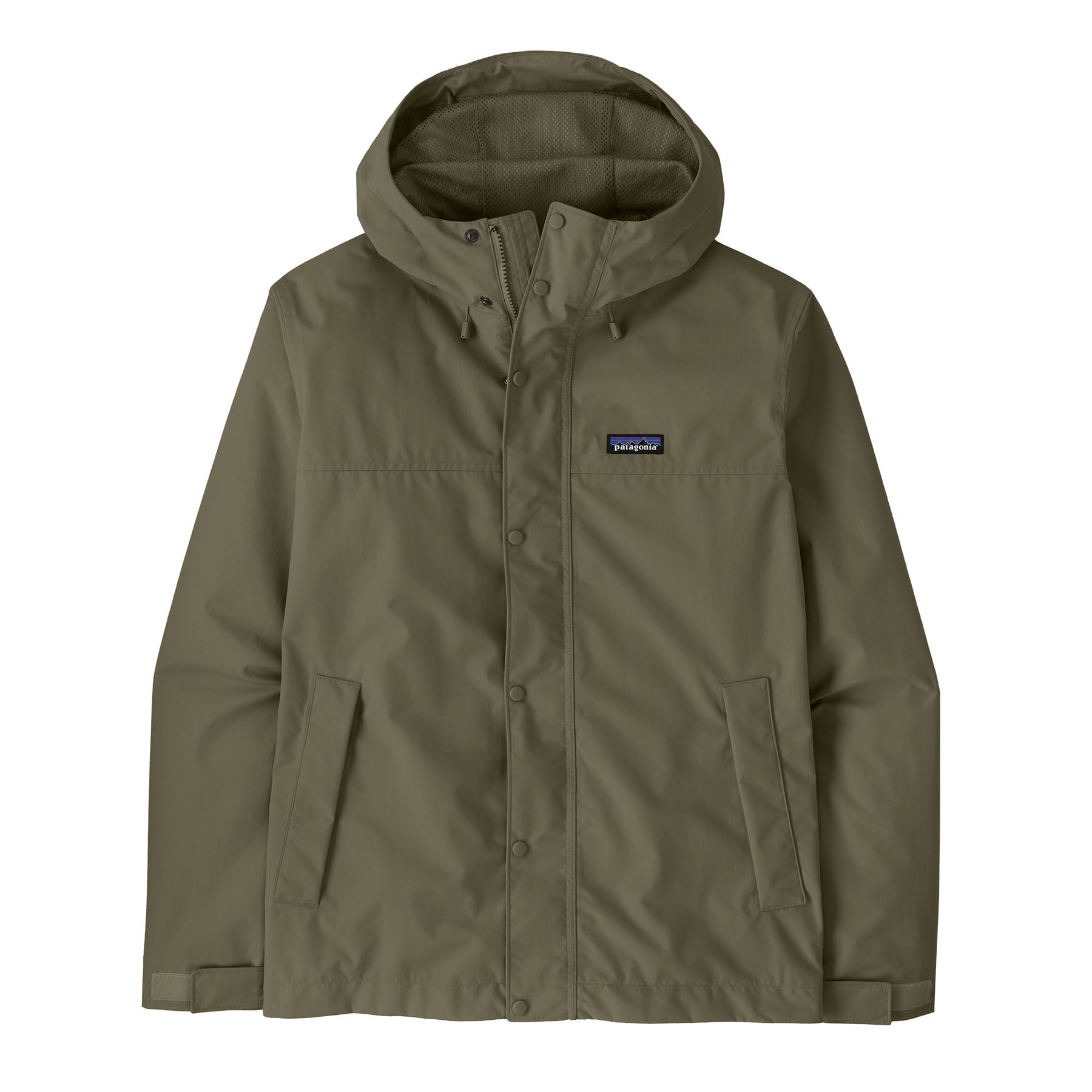
Explore this need in the finder →The Patagonia Men's Outdoor Everyday Rain Jacket is a regular-fit, two-layer rain shell identified on the current U.S. product page as style 20850. Its distinctive choice is not a specialty climbing feature or a minimum packed weight: it pairs a recycled-nylon faille shell with a soft mesh lining, a snap-covered front zipper and three zippered pockets. This assessment interprets Patagonia's published specification; it is not a report of wearing, rain testing, measuring or owning the jacket.
A lined two-layer shell, not a built-in insulation system
Patagonia describes the shell as a waterproof/breathable two-layer H2No Performance Standard construction. The face is 4.3-ounce, 70-denier NetPlus nylon faille made from postconsumer fishing nets, and the inside has a 2.3-ounce recycled-polyester tricot mesh with a wicking finish. The page calls this a lining, but does not include a separate insulating garment. That difference matters: a mesh layer can keep the coated shell from sitting directly against clothing, yet it is not the same purchase arrangement as the insulated Insulated Boulder Fork or Patagonia's 3-in-1 Heyes Peak system.
The exact listing gives Patagonia's H2No waterproof/breathable claim but no numerical hydrostatic-head or moisture-vapor figure. The construction label identifies the shell design; it cannot tell a buyer how the fabric will feel during a particular walk, commute or high-output outing. Nor does the listed weight answer whether a regular-cut garment will be comfortable over the layers someone owns. Those questions require information the manufacturer page does not supply, or an individual fit check that this review has not performed.
Daily storage is simple, but a self-stow route is not documented
Style 20850 has two secure zippered front pockets plus a third zippered pocket inside at the left chest. That provides a clear three-pocket map for keys, a wallet or small items, though Patagonia does not give pocket dimensions or say how contents sit beneath a pack strap. A center-front zipper closes under a protective snap-front placket. The arrangement covers the zipper with a separate fabric layer; it should not be confused with the two-way coated center zip, storm flap or dedicated venting hardware on Patagonia's alpine models.
The product page identifies an adjustable hood with a drawcord and hook-and-loop cuff closures. These let a wearer alter the opening in principle, but the listing does not state that the hood is helmet-compatible, and no individual helmet or glove test is available here. The checked feature list also does not name underarm pit zips. I therefore treat the jacket's pit-zip status as unconfirmed rather than inferring a vent from the mesh lining or front closure. Similarly, while one customer review on Patagonia's page mentions folding the jacket into its hood, the manufacturer does not identify one of the jacket's own pockets as a stow pocket; a pocket-stow must-have remains unsupported.
Material wording needs its own boundaries
Patagonia calls the face a 70-denier recycled-nylon faille. The product page does not call it ripstop, so it does not qualify for a shopper specifically requiring a recycled-nylon-ripstop face. The distinction is easy to lose when broad descriptions reduce every recycled nylon shell to the same material category. Here, the material is named as faille, and the mesh lining is a different layer.
The care and chemical notes are similarly specific. Patagonia says the DWR finish is made without intentionally added PFAS. That is a useful maker statement about the named finish, not proof that every component or the complete garment is absolutely PFAS-free. The listing gives no independent chemical analysis. Care instructions are machine wash cold, no bleach, tumble dry low, cool iron, no steam and no fabric softener; follow the garment's own label if it differs from an online page.
Weight and fit are comparison points, not test results
At 587 g (20.7 oz), the maker lists this at a higher weight than the 400 g men's Torrentshell 3L, the 470 g Pluma PRO, and the 343 g Dirt Roamer Storm. These are manufacturer figures, not independently checked measurements, and the jackets have different constructions and intended layouts. Weight alone does not prove weather protection, comfort or durability. Likewise, Patagonia's regular-fit label is a starting point for checking its size chart and intended layers, not a guarantee for a specific body.
One source-supported point in its favor is a plainly described everyday package: full-length front opening, adjustable hood and cuffs, a mesh lining, and pockets on both sides of the shell. For a buyer comparing office, campus or routine outdoor rainwear, that may be more relevant than a technical climbing hood or self-stowing pocket. The page does not specify a temperature range, packed size, pit-zip ventilation, abrasion test or numeric membrane result, so none should be assumed from the model's name or H2No label.
Who should compare it closely
Style 20850 deserves a close look if the wanted arrangement is an uninsulated men's regular-fit shell with a soft lining and three closed pockets. It is a less documented match for a buyer whose checklist requires pit zips, an own-pocket stuff route, a ripstop face or built-in insulation. Before ordering, verify style 20850, selected color and size, current package details and the seller's return terms. This assessment is based on Patagonia's U.S. product description and a retailer's exact Basin Green product photograph cross-checked to the style page; no personal fit, wet-weather or longevity result is claimed.
Key specifications
Key details at a glance
| Shell construction | 2-layer laminate |
|---|---|
| Manufacturer-listed weight | 587 g |
| Manufacturer fit label | Regular fit |
| Face fabric | 100% postconsumer recycled nylon faille |
| Manufacturer PFAS wording | Made without intentionally added PFAS |
Use the exact model’s instructions for operating limits, supplied equipment and version differences.
Sources for this review
Sources for this assessment
Build a shortlist from documented features
The finder compares explicit product facts, not a rain test, fit guarantee or promise of comfort.