
Your needs, this model
Does it fit your priorities?
How is the Men's Windshadow Jacket different from the Windshadow Parka?
The official U.S. pages identify two separate styles: Jacket 26490 has 80-g Thermogreen and a 760 g listed weight, while Parka 26495 lists 200-g insulation in the body plus 150-g in the hood and sleeves and 1,117 g. Patagonia gives neither a temperature range nor a common warmth test, so use those figures to distinguish the designs, not predict comfort.
Explore this need in the finder →Does style 26490 meet a must-have three-layer-shell requirement?
No. Patagonia describes this exact style as a two-layer H2No shell. Its 80-g Thermogreen is built in, and the page does not turn that construction into a three-layer specification.
Explore this need in the finder →Can I count on underarm pit zips or pocket stow for the Windshadow Jacket?
The checked feature list does not establish either a pit-zip vent or a pocket-stow method. Treat those fields as unknown for style 26490 and do not count the jacket as a confirmed match when either is essential.
Explore this need in the finder →Patagonia's Men's Windshadow Jacket is an insulated rain garment, not a shell-only layer: the current U.S. product page identifies style 26490 and lists a two-layer H2No shell, recycled-polyester taffeta lining and 80-g Thermogreen insulation. Patagonia lists a regular fit and 760 g (26.8 oz). These are manufacturer descriptions, not a claim that we wore, weighed or rain-tested the jacket.
A useful middle point within the Windshadow family
The Jacket is a distinct style from the Men's Windshadow Parka, style 26495. Patagonia's pages list 80-g Thermogreen and 760 g for the Jacket, versus 200-g insulation in the Parka body with 150-g in its hood and sleeves and a listed weight of 1,117 g. That is a real documented difference in build and mass, but the maker does not publish a temperature range or a comparable warmth test. The gram labels are not a common warmth scale, and a lighter insulated jacket is not automatically suitable for a particular forecast or activity.
Both are two-layer waterproof designs with recycled-polyester ripstop shells and taffeta linings. The Jacket page lists an adjustable drawcord hem; the Parka page we checked does not name that feature. The Parka page does explicitly list a snap storm flap, while the Jacket page names a front zipper but does not specify that flap. Treat that as a difference in published detail, not proof of the Jacket's construction beyond its own listing. Check the exact item and season before treating sibling names as interchangeable.
Two-layer fabric stack and qualified finish language
Patagonia describes the Jacket's shell as a 4.7-ounce, 150-denier, 100% recycled-polyester ripstop in a two-layer H2No Performance Standard construction. It also lists recycled-polyester taffeta lining; the materials section gives that lining as 2.2-ounce taffeta and notes a DWR finish. Hydrophobic PU lamination and a durable water repellent treatment are part of the described shell. Patagonia's wording says the relevant finish is made without intentionally added PFAS. That is a specific maker statement—not an unqualified assertion that every component or the entire garment is PFAS-free.
The specification does not supply a hydrostatic-head figure, breathability rate, test report, seam-tape description or pack volume. H2No is the maker's named standard, not a number that can be compared here against another jacket's test result. If a numeric threshold, a three-layer construction or a light, stuffable shell is essential, those are not established by this style's record.
Closures and pockets are practical, but not ventilation evidence
The spacious hood cinches with a drawcord; the page identifies a center-front zipper, adjustable cuffs and a drawcord hem. Together these provide several points to check when fitting the jacket over clothing or gloves. They do not establish how the openings seal in wind-driven rain, whether the front zipper is waterproof-rated, or how the jacket manages heat during sustained exertion.
Patagonia lists front handwarmer pockets, a left-chest security pocket and an internal chest pocket. It does not describe a pocket-stow arrangement, pocket dimensions or a confirmed underarm vent. For this assessment, pit zips and self-stowing remain unknown, not negative facts; a strict matcher requirement for either feature should not treat the jacket as verified. The recycled-polyester face also does not satisfy a recycled-nylon-ripstop requirement.
Fit, warmth and layering checks
The maker labels the fit regular. Use Patagonia's men's body-size chart as a starting point, then check the current style's fit notes and allow for the midlayer you actually expect to wear. A body chart is not a garment-measurement sheet, and the regular label cannot guarantee sleeve, shoulder or torso fit for a particular wearer. Because insulation is built into this model, it is not interchangeable with a shell whose warmth comes entirely from separately chosen layers. Decide whether that bundled arrangement suits your routine, and verify layering room rather than relying on the 80-g label to predict comfort.
For a three-layer insulated alternative in this library, the Men's Insulated Boulder Fork is a different 650-g listed configuration with a stretch liner and 40-g Thermogreen; it is not a direct warmth comparison. If the priority is an insulated style that is lighter on the manufacturer's scale, style 26490 is listed at 760 g, but neither that mass nor its insulation label is a temperature rating. If removable warmth matters, none of the checked product details establishes a detachable or zip-out liner for this Jacket.
Care, sourcing and limits of this assessment
The listed care is machine wash cold, no bleach, tumble dry low and no ironing; use the sewn-in label for the exact garment received. Patagonia says the lining fabric is bluesign approved, the jacket was made in a Fair Trade Certified factory and its country of origin is Vietnam. Those source statements do not tell us how long the garment will last or how it feels in use. We did not test water resistance, breathability, warmth, fit or durability, and the published page gives no numeric performance result.
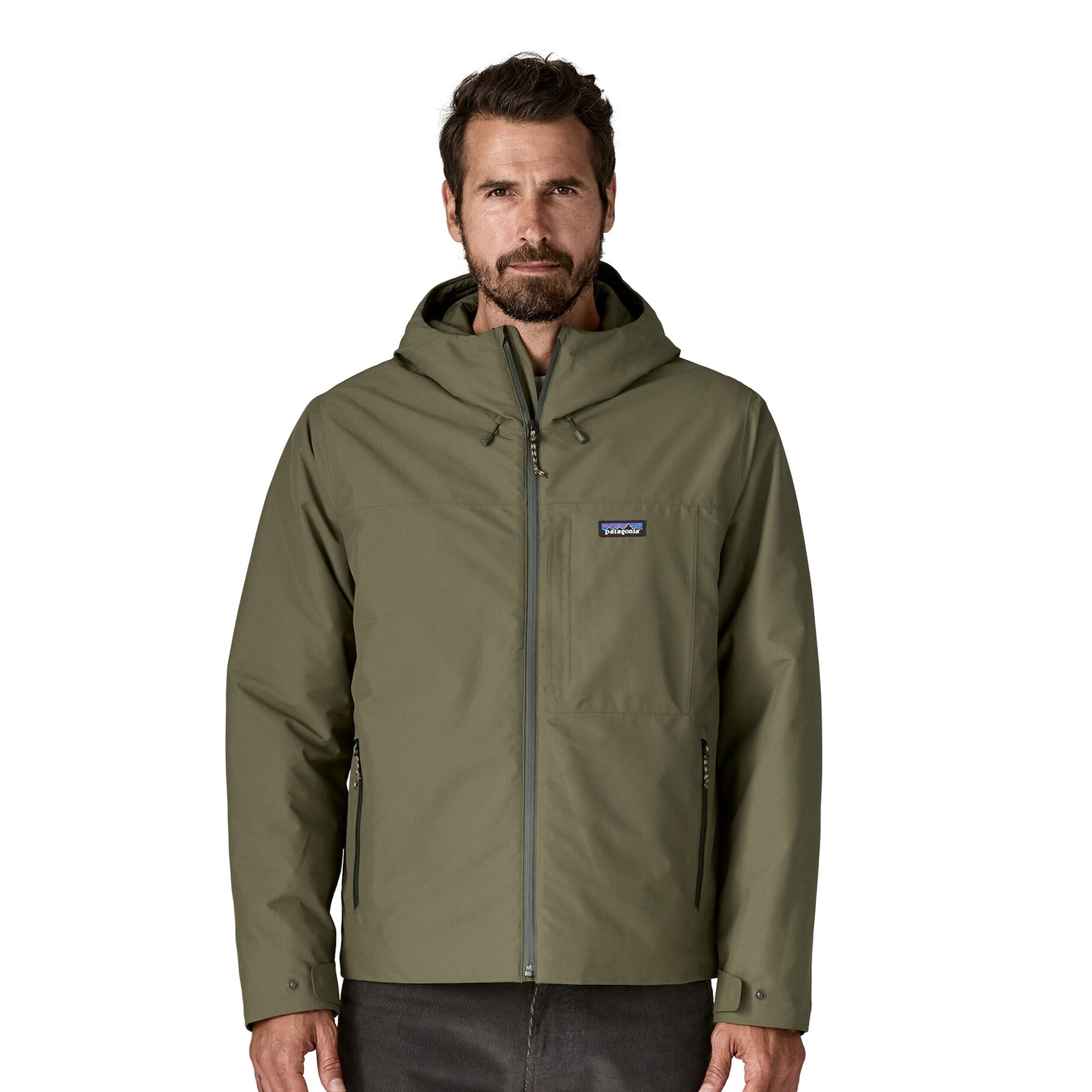
A retailer-hosted exact-style photo shows the Basin Green (BSNG) version; it is included to identify the Jacket, not to establish features or performance. Before choosing a listing, confirm Men's Windshadow Jacket style 26490 rather than Parka style 26495, check the exact color code and size, compare current care and construction details, and review the seller's return terms. The useful case for this style is its documented men's fit block, insulated two-layer arrangement, adjustable hem and relatively lower listed weight within its Windshadow sibling comparison—not a promise about personal fit, storm protection or warmth.
Key specifications
Key details at a glance
| Shell construction | 2-layer laminate |
|---|---|
| Manufacturer-listed weight | 760 g |
| Manufacturer fit label | Regular fit |
| Face fabric | 100% recycled polyester ripstop |
| Manufacturer PFAS wording | Made without intentionally added PFAS |
Use the exact model’s instructions for operating limits, supplied equipment and version differences.
Sources for this review
Sources for this assessment
Build a shortlist from documented features
The finder compares explicit product facts, not a rain test, fit guarantee or promise of comfort.